Thursday, February 9, 2012

Black Lightning (DuClaw Brewing Company)


I thank the Beer Club for hipping me to yet another brewery I probably should have investigated before now. DuClaw Brewing Company started in Bel Air, Maryland in 1996 and now has four brewpubs in the eastern part of the state. Their distribution is still limited to Maryland (minus the Eastern Shore), parts of D.C. and Northern Virginia, but I find that at least one of their beers, Black Lightning, is definitely ready for prime time.

It has quite a lovely appearance in my glass: opaque black with tiny-bubbled, tan foam that leaves behind some lacing. The aroma carries minty and herbal hops with roasted grain undertones.

There is a lot going on in the taste. In the main body I get sweet, smoky molasses, prune and espresso -- a lot of stout-like characteristics, actually, but with more hop flavor in the balance. There is some detectable alcohol as well. The body is medium to heavy, and mouthfeel is quite substantial. The finish is roasty and mildly bitter.

I find this beer wonderfully complex. It doesn't seem like just another contestant in the black IPA trend, but more like a style that deserves its place in the spectrum with schwarzbier, porter, and stout. Thumbs up from me, and recommended to lovers of dark things.

By the way, Morgan Schell from the marketing department at DuClaw tells me that the brewery has expansion plans that could bring their product to Delaware, Pennsylvania, and beyond in the next year or so. When I hear more I'll post an update.

From the bottle's label:

This medium-bodied American Black Ale is a stormy balance of thunderous roasted malt flavor and the aroma, bitterness, and electrifying finish of American hops. Pop it off, and get ready to... ride the lightning!

Featured beer:
Black Lightning

Tuesday, February 7, 2012

Noble Rot (Dogfish Head Craft Brewery)


You might notice these days that the flavor and character of beer is being discussed in the carefully nuanced terms once reserved for wine.

Dig a little deeper and you will find an enthusiastic community of collectors who seek out "ageable" beers and squirrel them away in the cellar as one would a bottle of Burgundy and Bordeaux. And it is now common for restaurants and brewpubs to offer beer pairing dinners, where a glass of stout or a goblet of Belgian ale will be placed alongside entrees and given legitimate gastronomic consideration.

At the same time that beer is finding a market with gourmet sensibilities, wine is reaching its broadest audience ever in the U.S. and is being consumed in record volume. Research by the Wine Market Council attributes these facts to the "wine boom" of the '70s and early '80s when baby boomers embraced wine, and to a similar adoption of the beverage in recent years by the generation known as the Millennials. Many are drinking wine on occasions and in settings that have been the traditional province of beer.

So, as the distinction between the beer and wine worlds blurs, Milton's Dogfish Head Craft Brewery has chosen an appropriate moment to release Noble Rot, which they describe as a "saison-esque" ale in which grapes contribute 49.5 percent of the fermentable sugar and the rest comes from traditional brewing grains. Noble Rot will be hitting shelves and taps over the next few weeks.

Although Dogfish previously experimented with grapes as a beer additive in their limited edition release Red & White, Noble Rot takes the grape-to-grain ratio to such an extreme that the resulting product can truly be called a beer/wine hybrid. "This is the absolute closest to equal meshing of the wine world and the beer world that's ever been done commercially," says Dogfish Head Founder and President Sam Calagione in the press release that accompanied our tasting sample.

While pinot noir juices were used in Red & White, the grapes in this latest concoction are specially cultivated viognier and pinot gris grown by Alexandria Nicole Cellars of Prosser, Washington. The viognier grapes have been infected with a benevolent fungus called botrytis (which French vintners called pourriture noble, or "noble rot"), which concentrates the sweetness of the grapes by reducing their water content. The pinot gris grapes have also undergone flavor intensification, in their case by a manual culling process.

To fairly evaluate this unique brew, I wanted to include the tasting impressions of an expert from the wine side of the house in addition to my own. I called around and eventually found someone even better suited to the task: Joe Hiester, who oversees the surprisingly extensive beer program at Wilmington's Domaine Hudson, a wine bar and restaurant with a wine list 425 bottles deep. Hiester, a 31-year-old Wilmington native, has been at the restaurant for about four years, prior to which he worked for Eclipse Bistro and Iron Hill Brewery.

Hiester and I arranged four wine glasses in front of us on the bar of the elegant yet cozy Domaine Hudson.

Into the first glass, as a reference for the saison style that Dogfish loosely targeted, we poured Hennepin Farmhouse Saison from Brewery Ommegang of Cooperstown, New York. This beer has a complex aroma that combines notes of lilac and honeysuckle with suggestions of yeast, pale malts, and banana bread. The taste is equally complex, first lemony and tart, then clove and cardamom notes over a fruity foundation, all lifted by effusive carbonation. Light grain and grass flavors are present in the dry finish.

Next, to get an idea of the grape flavors at play, we poured a glass of Domaine Saint-Amant Côtes du Rhône La Borry, made predominantly from viognier. In the bouquet of this wine I detected apple, overripe melon, and alcohol. In the mouth I noted low acidity, and flavors of weighty minerals and green apple.

To taste the particular effect of botrytis, we poured a glass of Domaine du Petit Paris Monbazillac, a dessert wine made in southwest France from handpicked botrytis grapes. The mouthfeel of this wine was dramatically heavier and oilier than the non-botrytis wine. It was sweet and densely flavorful, almost lush, with a slight citrus quality. In comparison with the Côtes du Rhône, I could not have asked for a clearer demonstration of the "noble rot" effect.

So now, fully grounded in every quality we might encounter, we turned to Dogfish Head's Noble Rot, which shined a bright straw color in the fourth wine glass. A reserved quantity of white foam is produced by the pour. The aroma is full and intriguing, and has unmistakable hints of Belgian character -- subdued spiciness, mustiness, and bread -- as well as unmistakable clues to the presence of sweet, tart grape.

There is a distinct contour to the beer's flavor: it starts with a blast of yeasty effects and fleeting, wine-like high notes, then drops into a solid white grape middle, and resolves in a long, meandering finish as the other threads drop off to a clean, light malt flavor. A hybrid, indeed, but as Hiester observed with approval, "At the end it tastes like I'm drinking a beer, and I love that."

It's fascinating to sort out on the palate all the ingredients and consider their role in this beer's maturing process. The grape component of Noble Rot does not share the slickness or sweetness on display in the Monbazillac. I imagine the Belgian ale yeast used to ferment this beer was ravenous for the sugars it found in the botrytized viognier must, and left behind only enough to hint at the grape's original flavor. The choice of pilsner malt and wheat as the grains was wise, as they are light enough not to conflict with the wine flavors, but have enough body to ride them out.

After a few cycles through the various libations we were comparing, Hiester noted, "I have all these things to drink in front of me: a nice French viognier, a saison beer that I've loved for a long time, and this Noble Rot. And I keep reaching for the Noble Rot."

As for its food pairing potential, we tried the beer with a few items from the Domaine Hudson menu. It proved a clean, refreshing accompaniment to the seared sea scallop with broccoli risotto, meshing with the savory flavors of the seared surface and providing contrast with the subtle, succulent inner meat. It worked even better against the chilled seafood salad, buoying the steamed Little Neck clams and Prince Edward Island mussels, while teasing out and boosting the fresh vegetable flavors of the finely diced red bell pepper, celery, Spanish green olives, and arugula.

Hiester, who helps his restaurant patrons pair beers with their meals, emphatically remarked: "I want food with this." Dogfish Head Craft Brewery can count that as a success.

Saturday, February 4, 2012

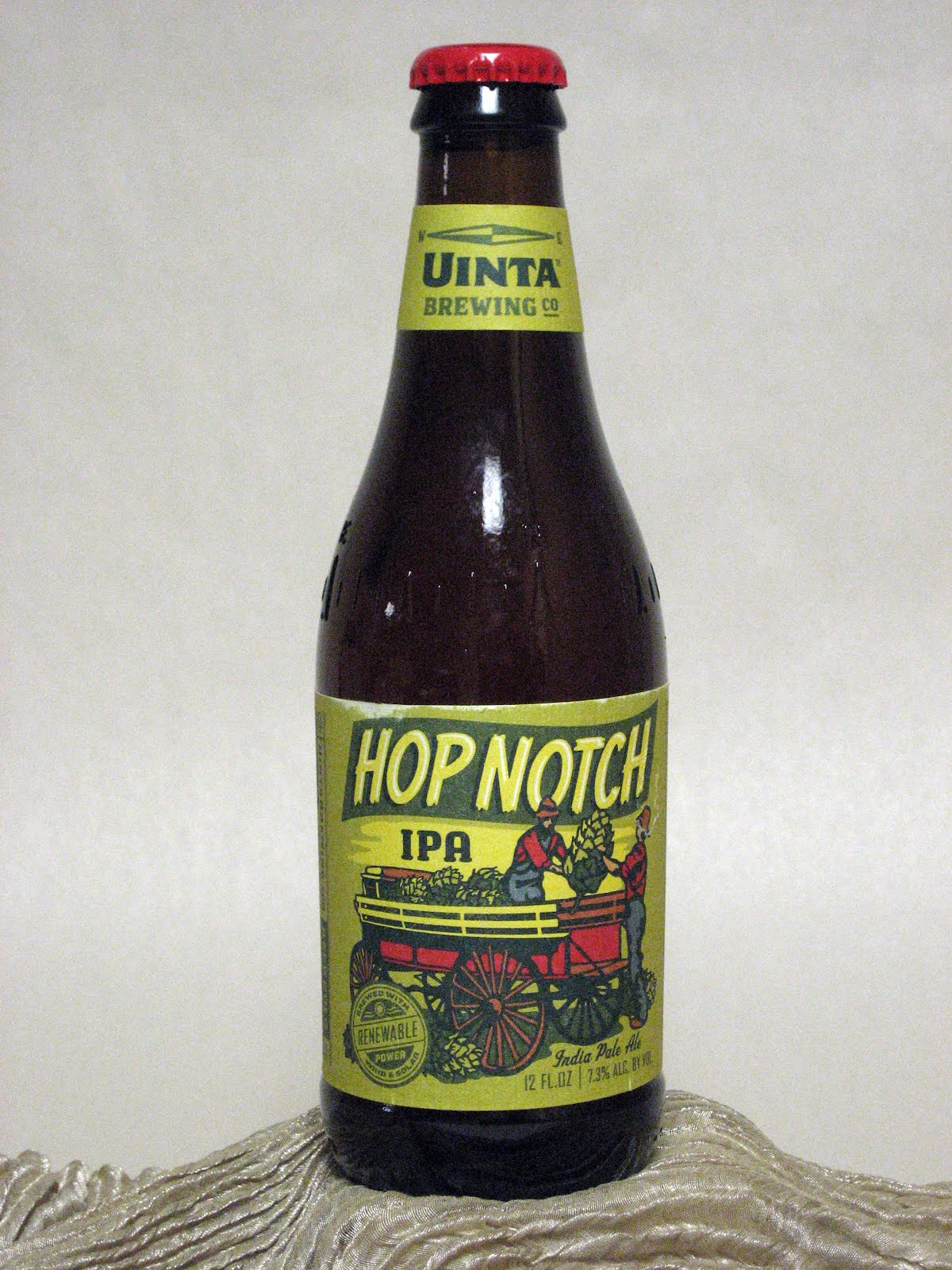
Hop Notch (Uinta Brewing Company)


I had never heard of Uinta Brewing Company before I spotted Hop Notch in the beer case at Avenue Wine & Spirits a few weeks ago. I'll admit that my decision to grab the six-pack was based only partly on a craving for something new, and mostly on the package design, which has a cool "retro" appeal similar to the graphics used by Great Divide Brewing Company. Also, each bottle has a compass dial debossed around its shoulder, which is a nice touch.

I felt justified in the superficiality of my impulse buy when I got home and did a little research about Uinta. From the Salt Lake City brewery's website: "Since 2001 Uinta Brewing has been 100% wind-powered, becoming the first Utah company to reach this mark. In an effort to continue its commitment to using renewable resources, Uinta Brewing installed solar-electric paneling on the brewery's roof in 2011."

Of course I realize that this factor does not affect the taste of the beer, but I'm always pleased to support a business that understands that commerce and the stewardship of natural resources need not be mutually exclusive pursuits. Then again, I wouldn't buy crappy beer from a company just because I admire its environmentalism, so let's see how this stuff tastes.

The beer pours a chill-hazed pale apricot color, with white, fluffy foam. Nice lacing as it drains. The nose is pungent and citrusy, leaving no doubt that hops will be the flavor's main attraction.

The grain sweetness of the body is tightly ensnared by bitter hops. The taste is almost savory -- the description "serious" comes to mind, as it did when I drank the commendable Red's Rye P.A. from Founders. The carbonation gives a foamy expansiveness to the mouthfeel. There is a hint of a grassy, herbal note as the flavor wanes -- something I found myself chasing after with every sip. The finish is long and bitter with some light malt flavors surfacing at the far end.

There is a ton of flavor to Hop Notch, and evidence of careful craftsmanship. For me, a very nice tasting IPA like this is often the gateway drug to a brewery's other offerings, so stay tuned. Congratulations to Uinta for breaking into the Delaware market and for everything else they're doing right.

Featured beer:
Hop Notch

Honorable mention:
Red's Rye P.A.


Friday, February 3, 2012

Beer Club (week 21)


Great Beer Club lineup this week! Got an awesome variety of stuff to drink during my week off.

• Bell Ringer (RJ Rockers)
• Black Jack Porter (Left Hand Brewing Company)
• Dig Pale Ale (New Belgium Brewing Company)
• Double Stout (Green Flash Brewing Company)
• Ruthless Rye IPA (Sierra Nevada Brewing Company)
• Schlafly Coffee Stout (The Saint Louis Brewery)

Tuesday, January 31, 2012

New destinations


Though the overall economy may be stuck with a stubborn case of anemia, the craft beer industry is clearly in vigorous health, growing by 12% last year, according to the Brewers Association trade group. In northern Delaware, that robustness is evident in the launch of three new businesses in nine months -- a neighborhood bar, a taproom, and a gastropub -- each proudly specializing in serving craft beer.

Two Stones Pub, a self-described "temple for beer," opened in April of 2011 at Chesmar Plaza in Newark, boasting 24 free-flowing taps of carefully selected craft brews and an equally enticing bottle menu.

Michael Stiglitz, the youngest and most adventurous partner in Rehoboth's Pickled Pig Pub, broke from that venture to open Two Stones and to bank on his sense that the beer culture in northern Delaware is ready to support a pub with a deep specialty in craft brews. In addition to the overall growth of the market segment, Stiglitz also cites Delaware's abundance of great local breweries and the state's general business friendliness as factors in the recent start-ups.

"You also have city people who are retiring to Delaware or moving here to find a less urban environment, but they've come to expect good beer," Stiglitz said.

Next on the scene was Ulysses American Gastropub at the Shoppes of Graylyn in Brandywine Hundred, also outfitted with 24 taps and a deep list of bottled beers. Its grand opening was on December 21, 2011.

General Manager Chris DiNuzzo agrees that the Delaware beer scene is hitting its stride. He left his job at the City Tap House in Philadelphia to come here and help it grow. DiNuzzo says being on the doorstep of the highly developed Philly craft beer market contributes to Delaware's fortunes, as does "our proximity to some of the most refined and progressive breweries in the world -- Dogfish Head, Victory, and Yards."

January 19 brought the beer scene its latest boost with the debut of Ernest & Scott Taproom on Market Street in downtown Wilmington. Its specialty will be cask-conditioned beers, small-batch spirits, and boutique wines.

Proprietor Scott Morrison, who also owns Chelsea Tavern just up the street, says, "I believe in the craft beer movement. Its growth has been phenomenal, especially in this bad economy."

But more than anything, his decision to start Ernest & Scott, with its unique cask offerings and exclusively craft beer menu -- sorry, no Corona or Miller Lite will be on sale here -- was influenced by conversations with influential beer advocate Sam Calagione of Dogfish Head Craft Brewing. "Sam was the one who really got me excited about cask beer, because it made sense to me as the natural outgrowth of the craft beer movement."

So it will be easier than ever for local beer lovers to try something new or quaff a previously obscure pint, but will this new wealth of destinations cause turf wars between the businesses? Not according Stiglitz, DiNuzzo, and Morrison, who were remarkably unanimous in their views.

"I think the greater good here is more important than competition. We all need to work together to help increase Delaware's access to beers, both from existing sources and new breweries," said DiNuzzo. Stiglitz feels similarly that his own work to forge better relationships with distributors benefits all Delaware beer bars. Morrison's philosophy is that "positive energy begets positive energy," and he embraces the mutually supportive approach of the New York restaurateurs he once worked among. " In the long run it's a net win."

But there are some differences between the three businesses that will distinguish them in the market. Two Stones, for example, works to create the feel of a traditional corner bar for beer lovers. "That's what we want to be," says Stiglitz. "A neighborhood bar with a really deep beer list."

For Ulysses American Gastropub, high quality food is a big factor. "It's a massive part and an intricate balance to make sure we're helping guests appropriately pair their beer with the meals they're having," says DiNuzzo.

The particular draw of Ernest & Scott, Morrison predicts, will be their cask beer program. His cellarmaster, Scott Witzlsteiner, has purchased a large batch of firkins (nine gallon casks that are usually drained using only gravity), which the breweries will fill with custom formulations of their standard releases. The current breed of well-informed beer connoisseur, Morrison says, "will travel long distances to taste and be part of something unique."

Friday, January 27, 2012

Demo (Magic Hat Brewing Company)


Magic Hat Brewing Company of Burlington, Vermont has been making enigmatically-named beers since 1994. By 2010 it had grown to be the 8th largest producer by volume of craft beer in the U.S., according to a list published by CNBC.com. Magic Hat's flagship beer is an apricot-infused "not-quite pale ale" called #9, which I have never been crazy about. Nor do I get a kick out of the "mystery meat navigation" on their website, which reveals things only when you click around, instead of allowing you to see everything at once and make choices easily. While it's not as obscure as it was 10 years ago, it still annoys to me.

But lest you think I have nothing positive to say about Magic Hat, let me tell you about sampling their black IPA, Demo. The bottle's "whimsical" artwork depicts a vinyl record with a hand-drawn label. Is the "demo" theme supposed to indicate that their recipe for this beer is unfinished? Not sure.

Anyway, when poured into my pint tumbler, the beer is deep, dark brown -- pretty close to black. Up comes an abundance of sturdy, picture-perfect light brown foam that leaves clumpy lacing all the way down the glass. The aroma is roasty and sweet, with a touch of mint and mineral.

The flavor is dark, round chocolate and coffee with a balance of floral hops that makes it really tasty. There is nothing spiky or bitter, and the pleasant smoothness is reinforced by the mouthfeel, which is just short of creamy. The roasted grain flavor is more chocolatey than the maltier Yakima Glory, a formidable black IPA from Victory. Demo's malt profile is almost like an Irish stout, but of course there's the more IPA-like hops activity here. (Apollo and Goldings are the varieties used.)

I'll probably never finish chiding Magic Hat for their too-clever website that makes it hard for me to learn about their products, but they have earned my admiration with this highly drinkable black ale. I have never been knocked out by their lighter beers, but their rich winter seasonal Howl (a lager) and now Demo have raised my interest in the darker end of their product spectrum.

Featured beer:
Demo

Honorable mentions:
Howl
Yakima Glory


Tuesday, January 24, 2012

Tweason'ale (Dogfish Head Craft Brewery)


Dogfish Head Craft Brewery has built its considerable fame on creating "off-centered ales" that defy the conventional wisdom of what beer is. It has done this, ironically, by reclaiming and embracing the actual glorious and diverse history of beer.

Exotic ingredients and sometimes bizarre brewing techniques have characterized the brewery's releases over 16 years. Guided by the vision of founder Sam Calagione, they eschew the famous German "purity law," the Reinheitsgebot (which decreed in 1516 that the only permissible ingredients for beer were water, barley, and hops), in favor of obscure -- like, hieroglyphic obscure -- recipes from all of history and all around the world. The brewmasters of Dogfish Head wipe their feet on the Reinheitsgebot on their way in to work.

So, it shouldn't be surprising that Dogfish, of all breweries, has taken a swing at a beer with one truly challenging production requirement: Must contain no grains! According to the brewery's website: "The No. 1 thing Dogfish lovers ask for at our pub, in our brewery and on our website is a gluten-free beer." The barley, wheat, or rye content in traditional beers can have grave effects on the digestive tract of a person who suffers from celiac disease or gluten sensitivity.

Dogfish has answered this challenge with its latest debut: Tweason'ale, a gluten-free, sorghum-based ale brewed with strawberries and buckwheat honey. They plan to release the beer in 12-ounce four-packs four times a year, interweaving it with their other popular seasonals (hence, the name).

Though not the first gluten-free beer on the market, Tweason'ale enters a niche with no dominant competitor. Surveying reader-submitted reviews of eight gluten-free beers on the website Beeradvocate.com, one finds they are not enthusiastically regarded, garnering an average rating of 2.76 out of a possible five. One critic summarized: "Drinking these beers always makes me grateful that I am not gluten intolerant."

Let's see for ourselves how Tweason'ale rates. Pouring the beer brings up big, fizzy bubbles that disappear straight away, leaving the crystal clear, pale copper-colored ale with no head. The aroma is very sweet, reminiscent of strawberry taffy, with an underlying darkness of husky grain.

Behind bright carbonation, the taste is surprisingly dense and flavorful, like a sour ale, offering green apple tartness backed by seedy strawberry sweetness before a quick, dry finish. Big tartness is definitely the main impression.

The flavor of Tweason'ale is distinctive, and certainly unusual in comparison with grain-based beers (apart from the Flemish sour ale, which it somewhat resembles). I would rate it a success on its own terms, but don't suspect it will become widely popular outside its niche. Hopefully the gluten-intolerant target audience will appreciate that Dogfish Head took another leap outside the box rather than brewing a neutered facsimile of a familiar style.

Featured beer:
Tweason'ale